If you have made it to this page, thank you so much for taking the time to know more about this research project and completing the online survey. Please click here to open a PDF with more information on the project. Also feel free to take a look through this blog if you want to know more.
Thanks again,
Willhemina Wahlin

Wednesday, 10 August 2011

Friday, 5 August 2011
The Rescuers goes further afield...
The Rescuers exhibition is going to now travel around Bosnia and Herzegovina. In addition, I will start designing a Bosnian language-only poster version of the exhibition, which will travel around to schools. For this, I will slightly change the design, bringing in more colour and less black.
Below are some photographs of the exhibition in Sarajevo. Initially, I was worried about the legibility of text when I saw that the bottom panel had not been tilted up at a 45 degree angle. Leora (curator of The Rescuers) said there were no problems with legibility, though, and I think the people in the photos below mostly look comfortable when reading. A good sign.
Photos are courtesy of Leora Kahn, PROOF: Media for Social Justice.


Below are some photographs of the exhibition in Sarajevo. Initially, I was worried about the legibility of text when I saw that the bottom panel had not been tilted up at a 45 degree angle. Leora (curator of The Rescuers) said there were no problems with legibility, though, and I think the people in the photos below mostly look comfortable when reading. A good sign.
Photos are courtesy of Leora Kahn, PROOF: Media for Social Justice.
 |
| Picturing Moral Courage: The Rescuers - exhibition in BBI Centar, Sarajevo, Bosnia. 14-15 July 2011. |


Monday, 18 July 2011
The Exhibition Opens!
Last Thursday, 14 July 2011, the exhibitions "Picturing Moral Courage: The Rescuers" opened in Sarajevo, Bosnia and Herzegovina. Below is a compilation of some of the footage taken on the night. The video snippets were sent by the curator, Leora Kahn.
Monday, 11 July 2011
The Rescuers - Education program
The Rescuers is not just an exhibition, but is part of a wider discussion of genocide prevention. I have just finished designing the three day conference program and information on panelists and keynote speakers, and it was very interesting to see the other side to this project, which I haven't really been involved in as designer, until the booklet design.
Part of my dissertation looks into education theories for the museum, and there are several reasons for this: firstly, visitor studies has evolved within museum studies from education theory (Hein 1998). While Visitor Studies is now explored in other fields of research, such as marketing (see Mencarelli, Marteaux and Pulh 2010), and is of growing importance to the field of museum studies in general (Macdonald 2006), its relationship with education theories is still highly relevant; it connects knowledge with learning, and increasingly positions the visitor as an active creator of meaning, rather than as a passive receiver of knowledge (Ebitz 2008; Hein 1998; Mayer 2005; Mason 2006).
The Rescuers exhibition and education program can be positioned between a constructivist and literary theory position; it allows for visitors to create their own meanings by not being overly didactic. Although it has large bodies of text, these are first-hand stories from the people that rescued others, not the words of the curatorial team. It is on the introduction panel only that the curatorial position is outlined, and serves to place the stories and images within a context for visitors, but does not provide them with an ultimate 'truth'.
The educational possibilities of the exhibition and the attached education program are quite different in terms of who they are directed to, but are essentially reflective of the same learning techniques found in contemporary educational theories, such as constructivism and literary theory.
From constructivism has sprung two theories of learning that have a growing acceptance within museum practice; Visual Thinking Strategies (VTS), devised by Housen and Yenawine (Mayer 2005; Goldberg 2005), incorporates the use of guided questions to encourage the construction of meaning by students/visitors. Falk and Dierking's Contextual Model of Learning (CML) places an emphasis on the context of learning beyond the object and into the realm of overlapping and interacting contexts of learning: the personal, sociocultural and physical (Mayer 2005; Falk and Dierking 1992; 2000).
It's important, then, that the rescuers stories are allowed to come to the fore, without much interference or suggestion from the curatorial team. However, it is also important that these stories be supported by a wider context which pitches the issues on a global stage, and encourages viewers to see beyond borders of nations, genders, races or religions, and are guided by the question of why and how genocide can be prevented and through which mechanisms. This question is encapsulated within the introductory panels of the exhibition, as well as on a much broader scale in the education program.
The visitors are markedly different from the public exhibition visitors: they are immersed in the three-day program and can also choose specific elements of the program, such as panel discussions. The information they will both receive and discuss will be much more extensive and intense, and will require both their attention and their participation. In addition, there are also more physical learning techniques being offered, such as break out sessions on learning through drama and sports.
What this program amounts to in terms of learning theory can be seen as including various elements of the theories mentioned above. For example, the visitor of both the exhibition and the conference is considered an active maker of meaning in constructivist terms. It also places the visitor in the various personal, physical and sociological contexts of CML, and, interestingly, also allows them to create their own narrative alongside that of the exhibition, as put forward by Roberts' branch of literary theory. It also tips a hat to dialogic looking, in that it encourages meaning making on three levels: internally (questioning a personal ability to rescue if needed), between partners (discussions between public exhibition visitors and conference attendees) and with the objects (the visual and textual objects of the exhibition, along with the films and other multimedia presentations during the conference). As VTS is based more on aesthetic learning, it only partially contributes as a theory, but is still important in terms of the visitor making connections between the visual and the textual in order to make meaning. The visual element and the creation of personal meaning is an important point to this exhibition, as its main focus is to unite people beyond borders.
Long gone are the exposition days of stacking art works upon each other from floor to ceiling; museums have an increasingly complex role within society as mimetic and mythical houses of cultural and historical representation (Mason 2006). Who and what is represented and how - not to mention who or what is not represented - has been the cause of wide debates in the last half of the 20th Century in particular. The rise of social concerns such lesbian and gay rights, feminism, multiculturalism, disability issues and civil rights (Mason 2006; Milner and Browitt 2002) has necessitated a review of issues of representation, and the need for a interdisciplinary approach that incorporates education theories, cultural theories and visitor studies; visual communication that links these elements is vitally important to also understand, and in particular how typography works as a tool of visual communication.
* This figure was provided by PROOF: Media for Social Justice, in private correspondence, but has not been as yet verified beyond this source.
* As this blog is acting as a work-in-progress, a full list of resources are not provided here. However, they will be included in my final dissertation. If there are any resources of interest, please feel free to leave a message below and I will provide them.
Part of my dissertation looks into education theories for the museum, and there are several reasons for this: firstly, visitor studies has evolved within museum studies from education theory (Hein 1998). While Visitor Studies is now explored in other fields of research, such as marketing (see Mencarelli, Marteaux and Pulh 2010), and is of growing importance to the field of museum studies in general (Macdonald 2006), its relationship with education theories is still highly relevant; it connects knowledge with learning, and increasingly positions the visitor as an active creator of meaning, rather than as a passive receiver of knowledge (Ebitz 2008; Hein 1998; Mayer 2005; Mason 2006).
The Rescuers exhibition and education program can be positioned between a constructivist and literary theory position; it allows for visitors to create their own meanings by not being overly didactic. Although it has large bodies of text, these are first-hand stories from the people that rescued others, not the words of the curatorial team. It is on the introduction panel only that the curatorial position is outlined, and serves to place the stories and images within a context for visitors, but does not provide them with an ultimate 'truth'.
The educational possibilities of the exhibition and the attached education program are quite different in terms of who they are directed to, but are essentially reflective of the same learning techniques found in contemporary educational theories, such as constructivism and literary theory.
First, a note on these theories
In constructivism, the visitor constructs knowledge by making connections between the object and their own lives, and is viewed as an active creator of meaning (Hein 1998; Mayer 205). More recently emerging Literary Theories provide an interesting framework also. Lisa Roberts (1997) argues that visitors don't merely accept the 'official narrative' put forward by museums, but construct their own narratives based on what they see (Mayer 2005; Roberts 1997). McKay and Menteverde (2003) present the notion of dialogic looking, a three-fold approach to learning that incorporates simultaneously occuring dialogues; those within ourselves, with partners, and with the objects themselves (Mayer 2005; Brady 2009). Both of these literary approaches act more as guides than definitive learning theories. From constructivism has sprung two theories of learning that have a growing acceptance within museum practice; Visual Thinking Strategies (VTS), devised by Housen and Yenawine (Mayer 2005; Goldberg 2005), incorporates the use of guided questions to encourage the construction of meaning by students/visitors. Falk and Dierking's Contextual Model of Learning (CML) places an emphasis on the context of learning beyond the object and into the realm of overlapping and interacting contexts of learning: the personal, sociocultural and physical (Mayer 2005; Falk and Dierking 1992; 2000).
The Rescuers - the exhibition
In the case of The Rescuers, the 'object' is both the photographs and the accompanying text/story). The spatial element of the exhibition is also important: it is not within the walls of a museum, but in a large outdoor space that attracts approximately 125,000 visitors a day.* Therefore, it is important to consider the visitor in the set up of the exhibition, and acknowledge that in many cases people will only partially view the exhibition on their way to somewhere else, and that they also will approach the exhibition from various angles, creating a decidedly non-linear view. In this regard, it's important to understand that visitors will take away a greatly varying impression of the objects. If they take in all of the information, they might come to understand the connection between the objects and the reasons why this connection is being made. If they only take in part of the exhibition, they still might come to an understanding of its theme (the prevention of genocide), but they might or might not make the connection between the object (the person and their story) and their own lives. In addition, because the exhibition is within one of the countries that conflict occurred in, it's very likely connections, regardless of the amount of content viewed, will be made made in a different way than if the exhibition was shown in another location that had no such history of conflict.It's important, then, that the rescuers stories are allowed to come to the fore, without much interference or suggestion from the curatorial team. However, it is also important that these stories be supported by a wider context which pitches the issues on a global stage, and encourages viewers to see beyond borders of nations, genders, races or religions, and are guided by the question of why and how genocide can be prevented and through which mechanisms. This question is encapsulated within the introductory panels of the exhibition, as well as on a much broader scale in the education program.
The Rescuers - the education program
The education program attached to the exhibition approaches both the material for learning and the visitors in another way. Along with viewing the exhibition, students are immersed in the program for 3 days, and are encouraged to actively participate in discussions, break out sessions, view films and be involved in Q&A sessions with the film makers, and listen to keynote speakers. Accompanying functions also enable the students to meet and discuss issues relating to the prevention of violence and genocide with some of the world's preeminent scholars and professionals in the world today (see the program above for more information).The visitors are markedly different from the public exhibition visitors: they are immersed in the three-day program and can also choose specific elements of the program, such as panel discussions. The information they will both receive and discuss will be much more extensive and intense, and will require both their attention and their participation. In addition, there are also more physical learning techniques being offered, such as break out sessions on learning through drama and sports.
What this program amounts to in terms of learning theory can be seen as including various elements of the theories mentioned above. For example, the visitor of both the exhibition and the conference is considered an active maker of meaning in constructivist terms. It also places the visitor in the various personal, physical and sociological contexts of CML, and, interestingly, also allows them to create their own narrative alongside that of the exhibition, as put forward by Roberts' branch of literary theory. It also tips a hat to dialogic looking, in that it encourages meaning making on three levels: internally (questioning a personal ability to rescue if needed), between partners (discussions between public exhibition visitors and conference attendees) and with the objects (the visual and textual objects of the exhibition, along with the films and other multimedia presentations during the conference). As VTS is based more on aesthetic learning, it only partially contributes as a theory, but is still important in terms of the visitor making connections between the visual and the textual in order to make meaning. The visual element and the creation of personal meaning is an important point to this exhibition, as its main focus is to unite people beyond borders.
So, how does this relate to typography?
In contemporary museum studies, there is an increasing emphasis on taking an interdisciplinary approach to the museum as text (Mason 2006; Macdonald 2006). The museum (or, in a wider context, exhibitions in general) is a place where objects of cultural significance are given a contextual framework for looking that is constructed. Within this framework sits typography, and as educational theories and visitor studies continue to grow in importance, typography, it can be argued, has much to contribute. It provides information on both a connotative and denotative level; it guides, it educates, it provides visual links between objects, ideas and information, and it entertains (or, sadly, the opposite if not designed properly). Typography can encourage or discourage the deeper reading of what Baxandall (1991) termed 'labels' - that is, anything attached to the exhibition of a textual nature, such as catalogs, labels, postcards, posters - anything that provides information or ideas.Long gone are the exposition days of stacking art works upon each other from floor to ceiling; museums have an increasingly complex role within society as mimetic and mythical houses of cultural and historical representation (Mason 2006). Who and what is represented and how - not to mention who or what is not represented - has been the cause of wide debates in the last half of the 20th Century in particular. The rise of social concerns such lesbian and gay rights, feminism, multiculturalism, disability issues and civil rights (Mason 2006; Milner and Browitt 2002) has necessitated a review of issues of representation, and the need for a interdisciplinary approach that incorporates education theories, cultural theories and visitor studies; visual communication that links these elements is vitally important to also understand, and in particular how typography works as a tool of visual communication.
* This figure was provided by PROOF: Media for Social Justice, in private correspondence, but has not been as yet verified beyond this source.
* As this blog is acting as a work-in-progress, a full list of resources are not provided here. However, they will be included in my final dissertation. If there are any resources of interest, please feel free to leave a message below and I will provide them.
Friday, 24 June 2011
The panels.
The panels have gone off to the printer; we had one slight hiccup with some logos that need to be added to the introduction panel, which the printer is waiting for, but aside from that, everything has been checked, and checked again. Below are all the panels.
Title panels


Bosnia


Cambodia


Rwanda


Holocaust


Thursday, 16 June 2011
Design update
It has been a while since I posted any updates, and that is basically because I've been busy with all the panel designs. The first round is completed, plus the first round of proofreading, and they are now in the second round of proofreading. I have also gone through each panel and checked the English, so there are at least 3 people checking everything. Below is one of my favourite panels.


Incidentally, I've been to Cambodia four times, and lived and worked there also, and when I look at Romny's image and read her story, I'm reminded of all my friends there; their stories, their families that were killed, and their hearts. Being part of this project is just such a gift.
A film has been made about one of my best friends in Cambodia, Aki Ra. Here is the trailer.


Incidentally, I've been to Cambodia four times, and lived and worked there also, and when I look at Romny's image and read her story, I'm reminded of all my friends there; their stories, their families that were killed, and their hearts. Being part of this project is just such a gift.
A film has been made about one of my best friends in Cambodia, Aki Ra. Here is the trailer.
Saturday, 4 June 2011
Update on designs
The panels are now being designed. Because a lot of preliminary work has already gone into the main panels, I don't think they will take so long to create, but I knew that the title panels would be the big problem, as they need to include a lot of information in very little space. First, the main title for the exhibition is below. This had to include the message from General Dallaire.
 |
| Main panel at 21%. |
 |
| Bottom panel with Dallaire's message in Bosnian and English, 21%. |
 |
| The panels together. 15%. |
 |
| Dallaire's message in Bosnian, 100%. |
 |
| Title, 100%. |
 |
| Logos, 100%. |
The introductory panel includes information on the exhibition, the photographers, PROOF, organisations involved in the project and a map showing the different regions and stats.
 |
| Zoomed out to 15%. This shows the top and bottom panels together. Colour links the countries/regions to their information, as well as the the photographer who worked in that region. |
 |
| Main panel. 25%. |
 |
| The map in detail. |
 |
| Detail on countries. |
 |
| 100%. Information on Rwanda. |
 |
| Type at 100%. |
 |
| Bottom panel type - info on photographers. 100%. This type has to be smaller than the main panels, due to the amount of information that has to be included, but it is still easy to read. |
 |
| Colour links the photographer to the region they worked in. |
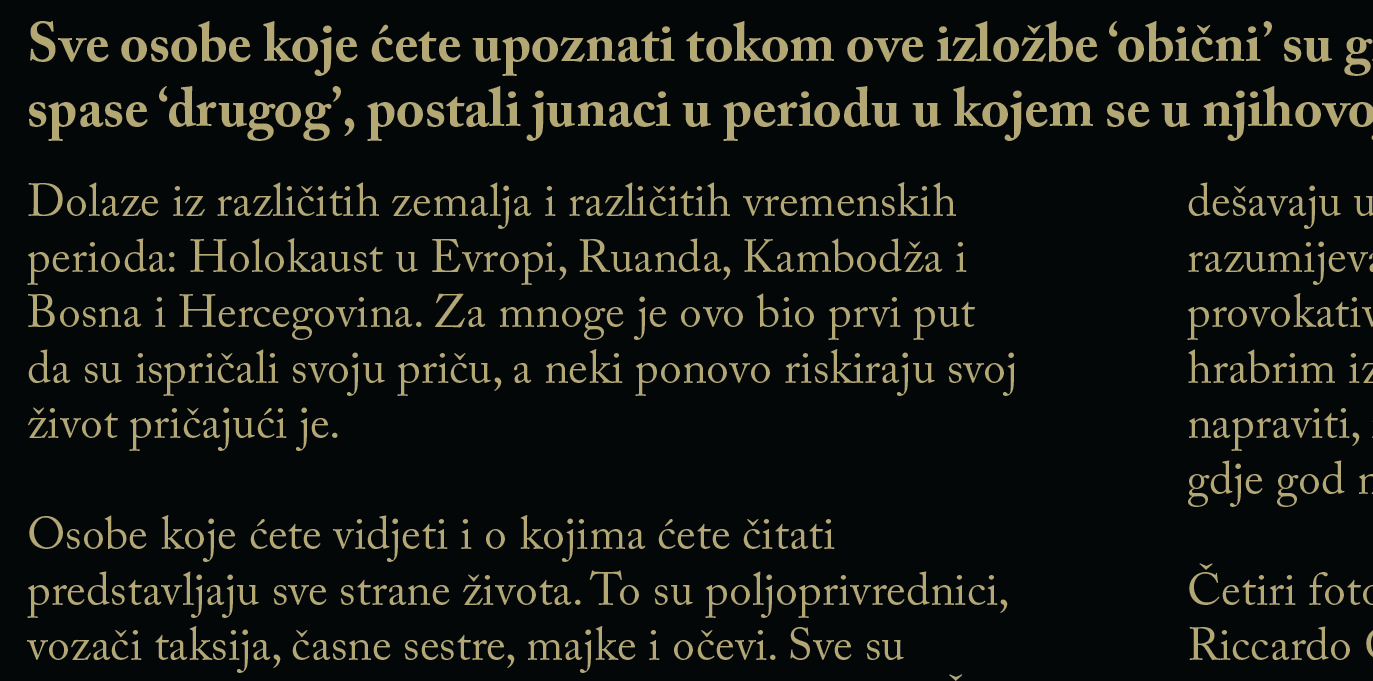 | ||
| Text of the introduction to the exhibition, on the main panel. 100%. |
There has been one important change to the main panels - the breakout quotes are now on the main panel and the main body of text on the smaller one. This is so you can look down and read the larger body of text more comfortably, but as there will be a lot of people passing through the square where the exhibition is, it was thought the breakout quotes could still be read by them easily, giving them a sense of what the exhibition is about even if they can't stop to read the whole thing.
 |
| Breakout quotes on the main panel allow passers-by to get snippets of information about the exhibition, even if they can't stop to read the whole text. |
Subscribe to:
Posts (Atom)